Contract Testing: Prevent Breaking Changes Before Production
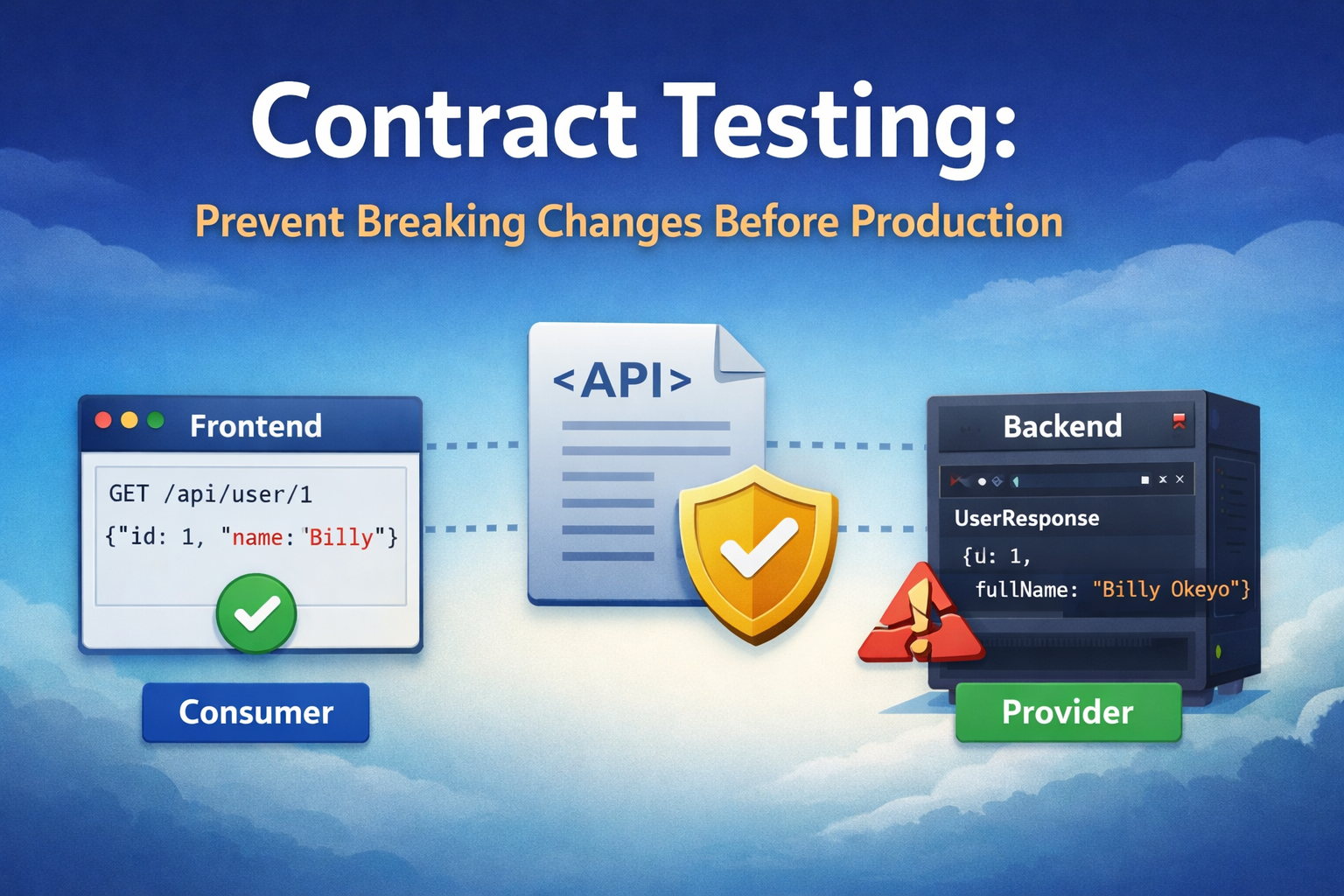
“It worked locally. Tests passed. But production still broke.”
If you’re building distributed systems with multiple services and frontends, you’ve likely encountered this (whether using .NET + Angular, Node.js + React, Python + Vue, or any combination):
- A backend change gets deployed
- The frontend suddenly breaks
- No tests warned you
The issue isn’t always logic.
It’s often a broken contract between systems.
The Problem: Silent API Breakages
In a typical setup:
- Service Provider: An API or microservice
- Service Consumer: A frontend, app, or another service
- Communication: JSON over HTTP (or any protocol)
Everything depends on one thing:
The consumer and provider agreeing on what data looks like
A Real Example
Let’s use a .NET API and Angular frontend as an example (though this applies to any tech stack).
API Provider (Initial Version)
1
2
3
4
5
6
public class UserDto
{
    public int Id { get; set; }
    public string Name { get; set; }
    public string Email { get; set; }
}
1
2
3
4
5
6
7
8
9
10
[HttpGet("{id}")]
public IActionResult GetUser(int id)
{
    return Ok(new UserDto
    {
        Id = 1,
        Name = "Billy",
        Email = "billy@example.com"
    });
}
Consumer Interface (Angular Example)
1
2
3
4
5
export interface User {
  id: number;
  name: string;
  email: string;
}
Everything works perfectly.
Then a “Small” Change Happens
1
2
3
4
5
6
public class UserDto
{
    public int Id { get; set; }
    public string FullName { get; set; } // renamed
    public string Email { get; set; }
}
Production Result
1
user.name //  undefined
The UI breaks.
Why Didn’t Traditional Tests Catch This?
- Unit tests → passed (backend logic is fine)
- Integration tests → passed (they used the old model)
- The API still returns valid JSON
But the contract between systems changed—and traditional tests don’t verify that.
What is Contract Testing?
Contract testing ensures that your service provider always matches what the consumer expects.
A contract defines:
- Request format
- Response structure
- Required fields
- Data types
In Simple Terms
The consumer (frontend, app, or service) defines expectations The provider (API or service) must satisfy them
Consumer vs Provider
Consumer
- Calls the service/API
- Defines expected structure
- Examples: Angular frontend, React app, mobile app, another microservice
Provider
- Returns the data
- Must not break expectations
- Examples: .NET API, Node.js backend, Python service, GraphQL endpoint
How Contract Testing Works
Instead of relying only on integration tests:
- Angular defines expectations
- A contract file is generated
- .NET verifies the contract
Flow
1
2
3
4
5
6
7
Consumer Test (e.g., Angular)
      ↓
Generates Contract
      ↓
Saved as JSON/YAML
      ↓
Provider verifies against contract (e.g., .NET API)
Practical Example
(.NET backend + Angular frontend as an example)
Step 1: Define Expectations in Consumer (Angular example)
1
2
3
4
5
6
7
8
9
10
const expectedUser = {
  id: 1,
  name: "Billy",
  email: "billy@example.com"
};

it("should fetch user correctly", async () => {
  const user = await userService.getUser(1);
  expect(user).toEqual(expectedUser);
});
Generated Contract (Simplified)
1
2
3
4
5
6
7
8
9
10
11
12
13
{
  "request": {
    "method": "GET",
    "path": "/api/users/1"
  },
  "response": {
    "body": {
      "id": 1,
      "name": "Billy",
      "email": "billy@example.com"
    }
  }
}
Step 2: Verify in Provider (.NET API example)
Install Pact:
1
dotnet add package PactNet
Provider Test
1
2
3
4
5
6
7
8
9
10
[Fact]
public void VerifyPact()
{
    var pactVerifier = new PactVerifier();

    pactVerifier
        .ServiceProvider("UserApi", "http://localhost:5000")
        .WithFileSource(new FileInfo("pacts/userapi-angular.json"))
        .Verify();
}
If Provider Breaks the Contract
1
public string FullName { get; set; }
The test fails immediately
You catch the issue before deployment
Where Contract Testing Fits
1
2
3
4
5
6
7
8
9
10
11
E2E Tests
(user journeys)

Integration Tests
(service interactions)

Contract Tests
(API agreements)

Unit Tests
(business logic)
Why This Matters in Real Projects
Safer Refactoring
Change DTOs, schema, or API responses without fear. Contract tests verify nothing broke.
Independent Development
Consumer and provider teams move faster. Changes are caught instantly, not in production.
Faster Debugging
Failures clearly show what broke
Stronger CI/CD Pipelines
1
2
3
Consumer Build → Generate Contract
Provider Build → Verify Contract
Deploy → Only if both pass
This works with any tech stack.
Common Mistakes
Over-Specifying Data
Bad:
1
"name": "Billy Okeyo"
Good:
1
"name": "string"
Testing Everything
Only validate fields your frontend actually uses
Ignoring Versioning
Breaking contracts without versioning leads to production issues
Best Practices
Keep Contracts Minimal
Focus only on required fields
Version Your API
1
2
/api/v1/users
/api/v2/users
Automate in CI/CD
Contracts should be generated and verified automatically
Use Realistic Data
Avoid unrealistic mocks
Final Takeaway
Unit tests verify logic Integration tests verify systems E2E tests verify user flows
Contract tests verify agreements
“Most production bugs aren’t failures… they’re misunderstandings between systems.”
Contract testing eliminates those misunderstandings.